Skip to the case for Kairo

The software abusiness runs itswhole day on

Bookings, payments, client records and every message — one system, one login. $410 once, then nothing per month.

Built in a working businessScroll ↓

The problem

You don't losemoney on theappointment.You lose itbetween.

Most of the admin in a business that runs on appointments happens in the gaps. Every one of these costs money, and none of them is anyone's actual job.

  • 01

    The empty chair

    A slot nobody filled, because nobody had time to notice it was open.

  • 02

    The client who drifted

    They did not leave. They just stopped booking, and nobody followed up.

  • 03

    The no-show

    The appointment nobody reminded them about, in a diary nobody had time to work.

  • 04

    The change nobody passed on

    A time moved, and the only person who knew was the one who moved it.

No commission

  • 01

    The diary

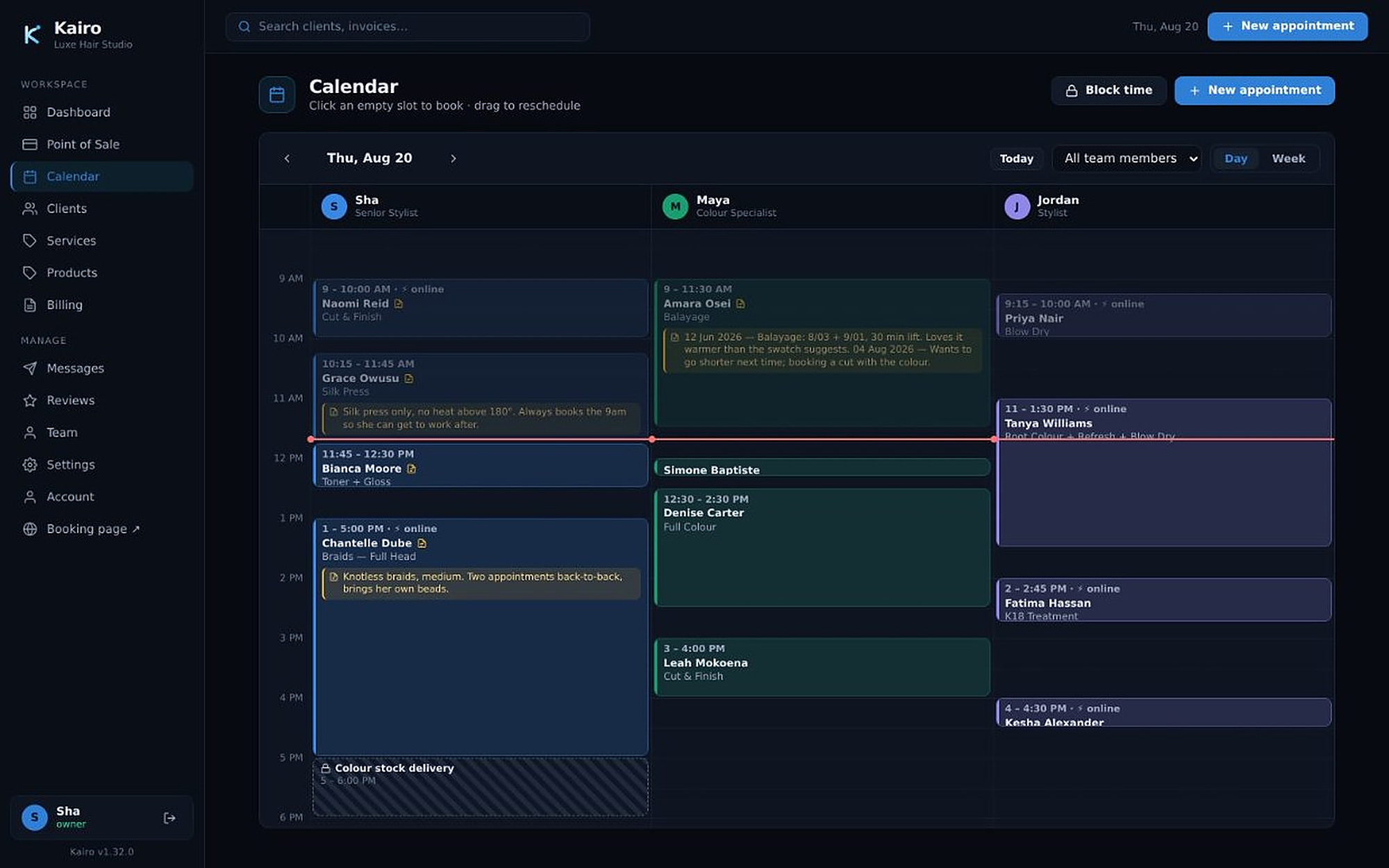
    The diary that cannot double-book

    A column per person, each block the real length of the job. It cannot be double-booked.

    The Kairo calendar in day view, three staff columns with colour-coded appointments and a blocked delivery slot.
    • A column per person.
    • Blocks the real length of the job.
    • Drag to reschedule.
    • Two people booking at once still cannot clash.
  • 02

    The client

    Everything you know about them, on one card

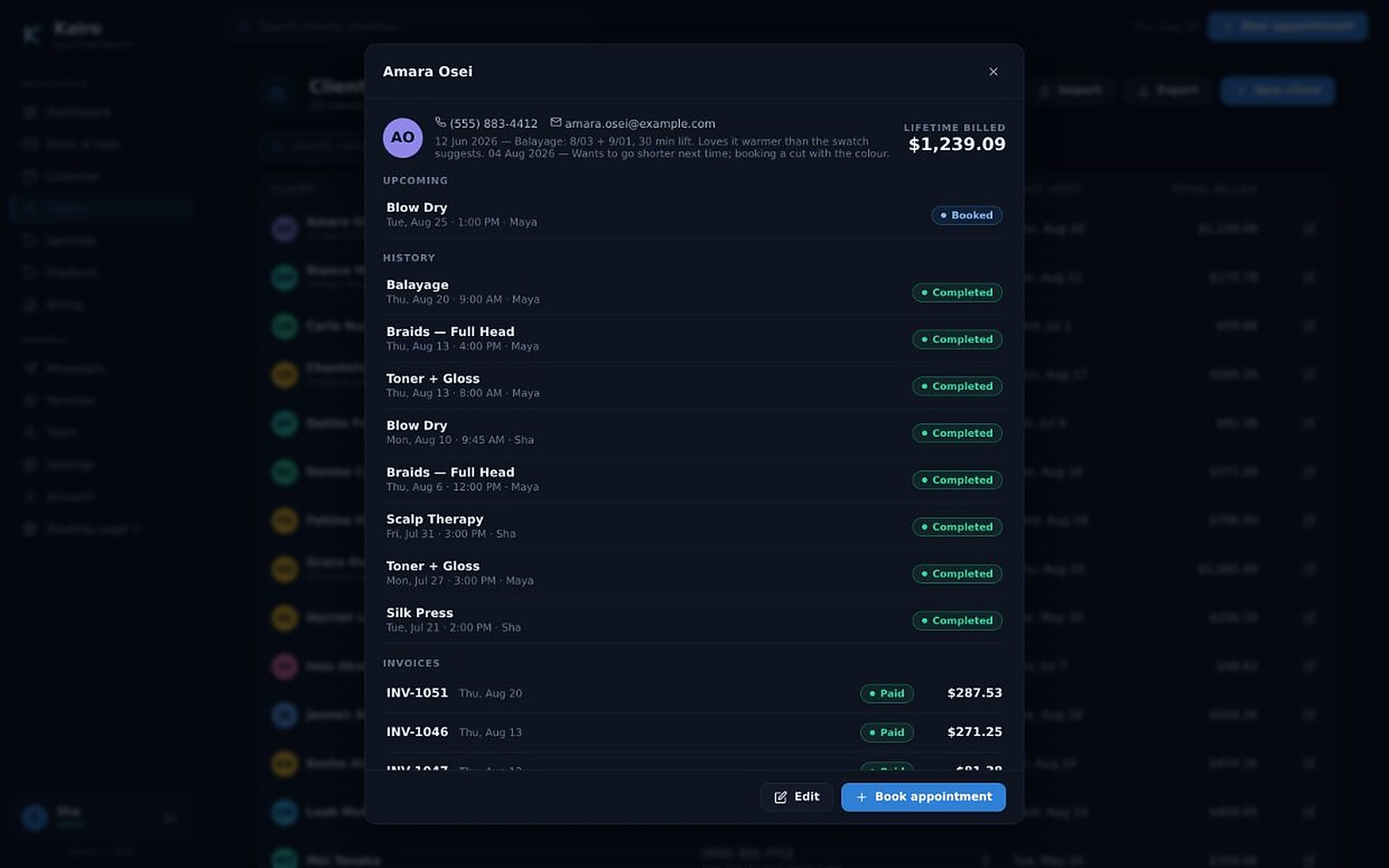
    Every visit, every invoice, and the notes that matter — on one card.

    A client record showing upcoming bookings, full visit history, invoices and lifetime spend.
    • Every visit and invoice.
    • Notes that follow the client.
    • Allergies and patch tests on the appointment.
    • Lifetime spend, at a glance.
  • 03

    Getting paid

    From the chair to the bank

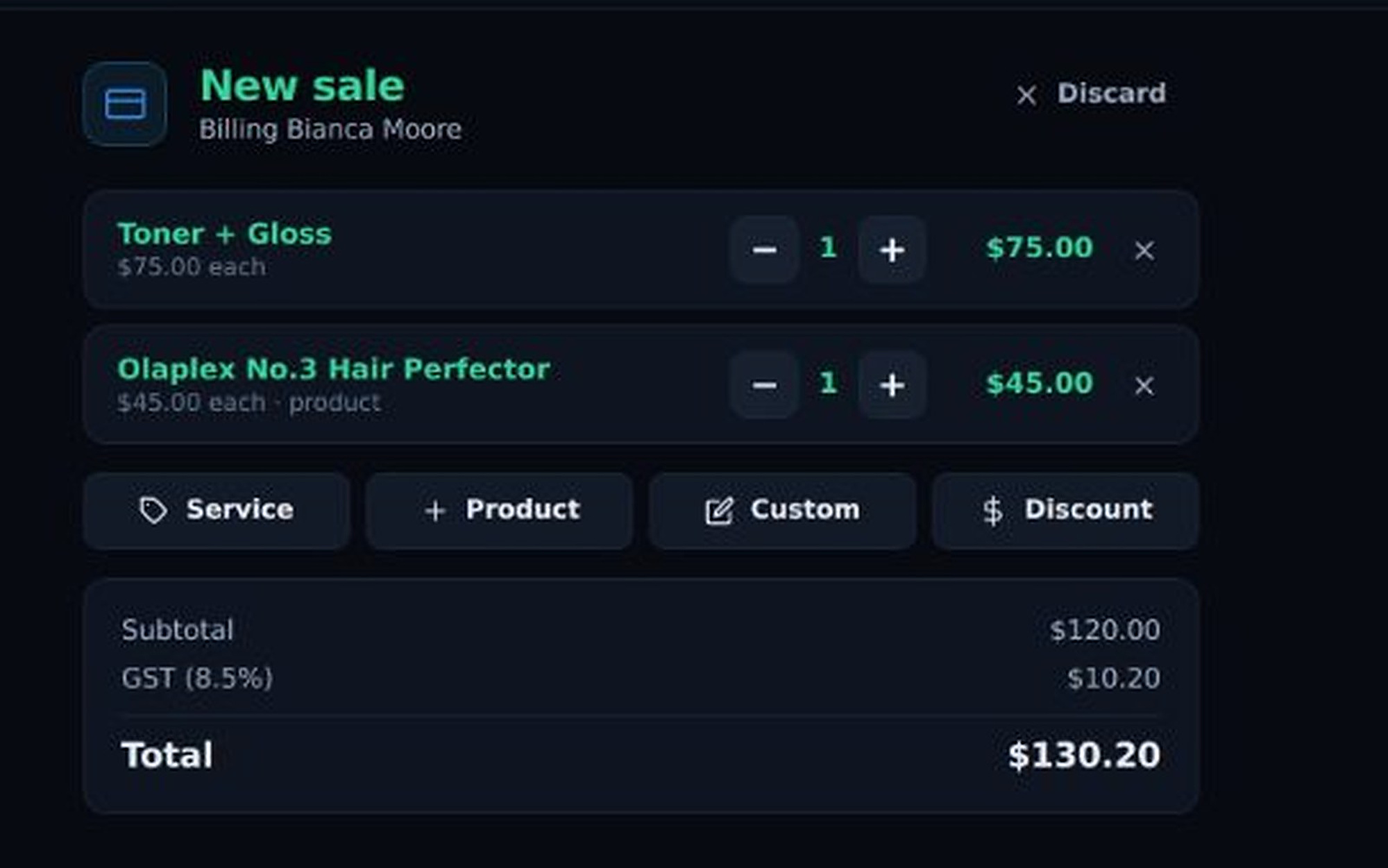
    Bill the appointment or ring up a walk-in, service and retail on one sale.

    The point of sale with a service and a retail product on one sale, subtotal, GST and total.
    • Bill from the chair.
    • Service and retail on one sale.
    • Card payments through Stripe.
    • Receipts sent automatically.
  • 04

    The messages

    Nothing sends silently

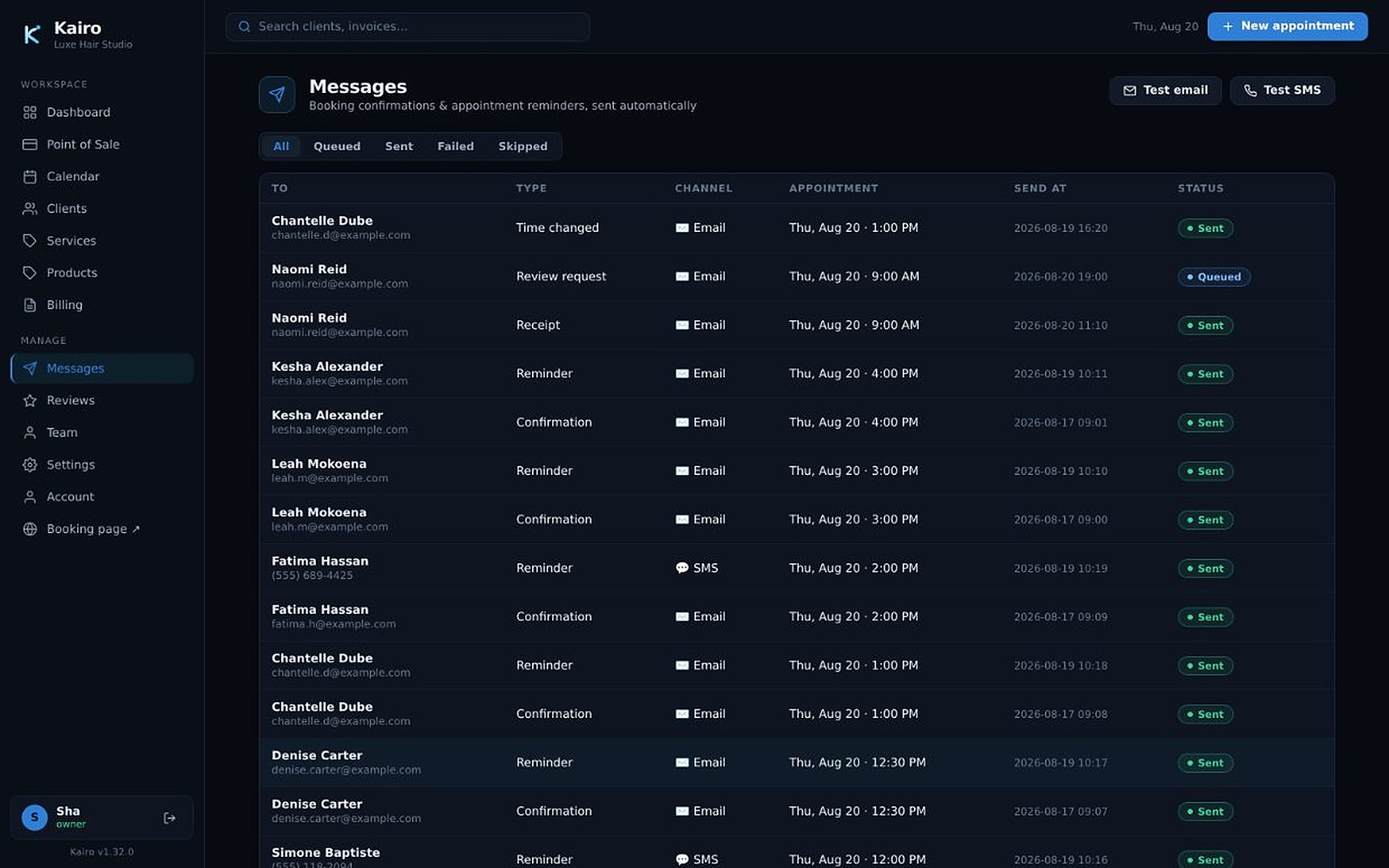
    Every confirmation, reminder and receipt, with the status it was delivered under.

    The message log listing confirmations, reminders and receipts by channel with delivery status.
    • Confirmations, reminders, receipts.
    • Email or text.
    • Every message logged with its delivery status.
    • Marketing separate from transactional.
  • 05

    What they see

    Your own link, your name at the top

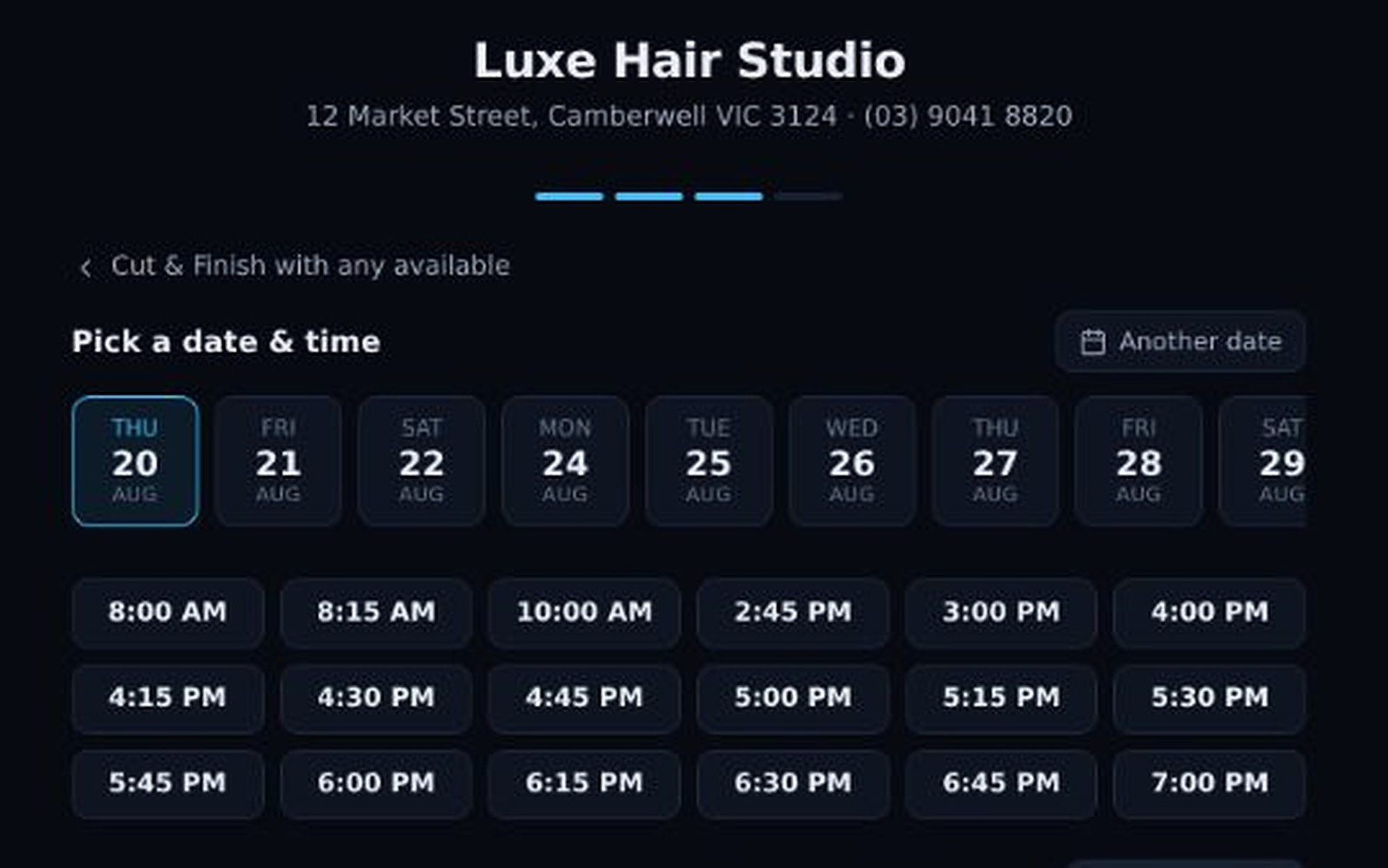
    Your own link, your name at the top, and only the times you can actually take.

    The public booking page showing the business name, a date strip and the available times.
    • Your name at the top, not a marketplace.
    • Only the times you can actually take.
    • Re-checked at the moment of confirming.
    • Never goes stale.

The assistant

Talk to yoursoftware.It does theclicking.

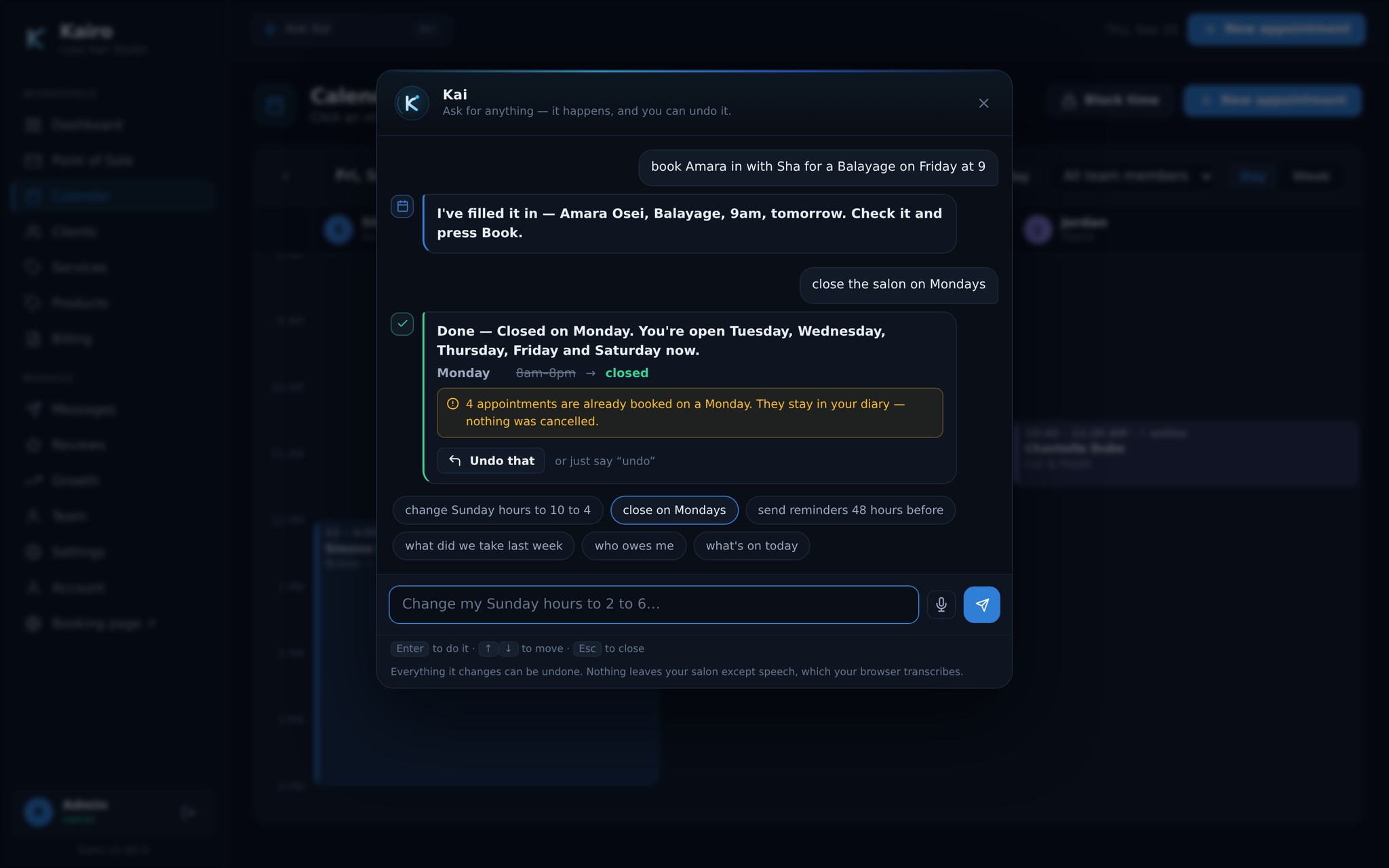
Kai sits in every screen. Say what you want in your own words and it goes and does it — your hours, your prices, your reminders, your booking rules. Every change it makes comes back with an Undo sitting next to it.

Nothing leaves your salon. No language model, no cloud service, nothing sent anywhere — which is part of why there is nothing to pay per month.

  • close the salon on Mondays
  • book Amara in with Sha for a Balayage on Friday at 9
  • what did we take last week
  • send reminders 48 hours before
  • show me the calendar in three days
Kai answering two instructions inside Kairo: one books an appointment and fills the form in, the other closes the salon on Mondays and offers to undo it.

One sentence

“Book Amara in with Shafor a Balayageon Friday at 9.”

Kairo opens the calendar on that Friday with the whole booking already filled in — client, service, stylist, time, duration, price. One press and it is in the book.

Kairo showing a new appointment already filled in from a typed sentence: Amara Osei, Balayage, 9am tomorrow, with the calendar open behind it.

It stops there on purpose. It fills the booking in; you press Book. A booking texts a real person, and there is no undo for a message that has already arrived — so the last step is always yours.

If the slot is a problem it says so before you press: closed that day, outside your hours, or that stylist already busy.

The paperwork

Patch tests,consents andbefore-afters.

Colour needs a patch test, and insurers expect the record. Most salons keep it in a paper book or a notes field — which is not evidence if anyone ever asks.

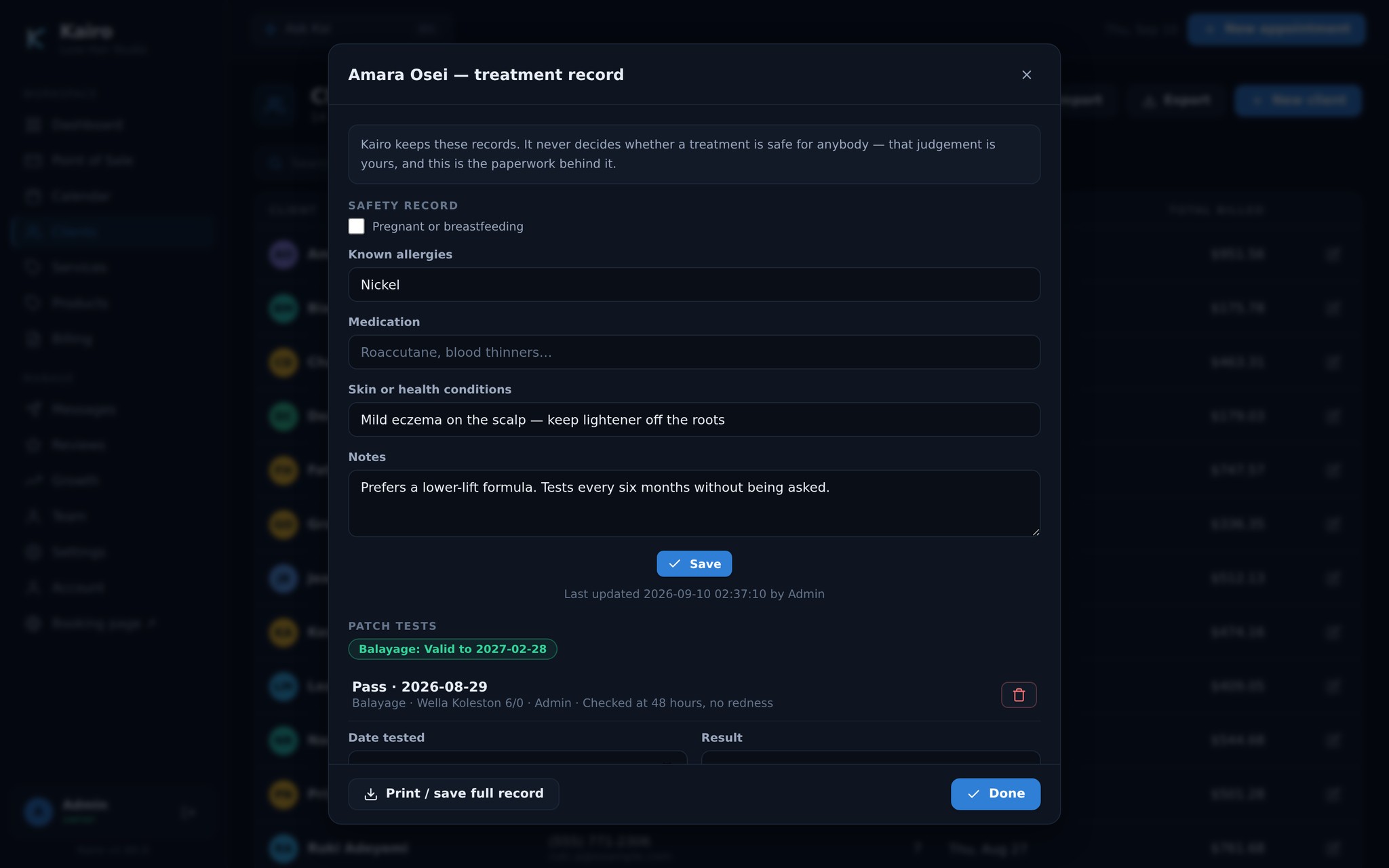
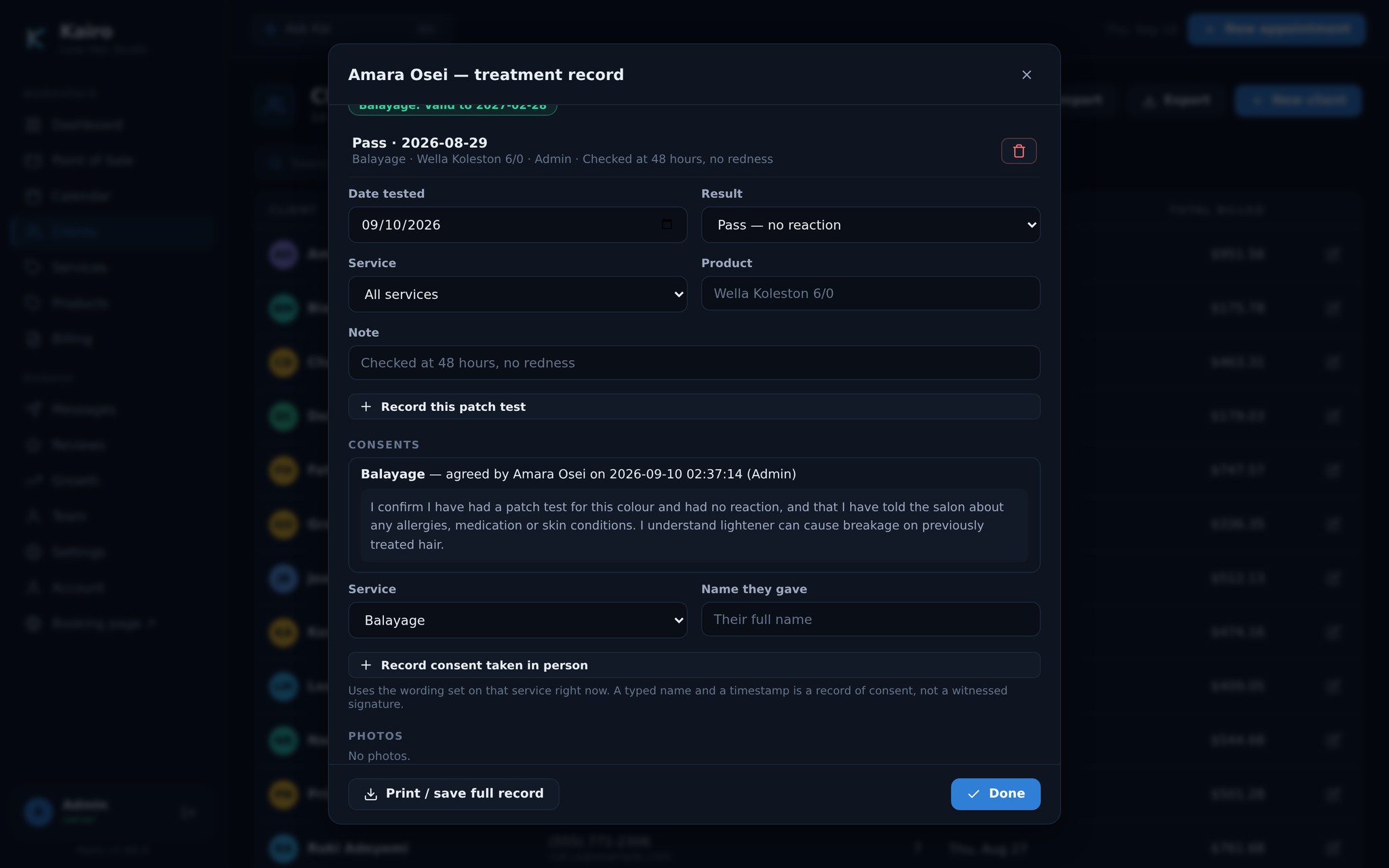
Kairo keeps it properly: who was tested, on what date, with which product, and what happened. Consents store the exact wording the client agreed to and the moment they agreed to it. Photos attach to the appointment they belong to.

Kairo records; it never decides. Nothing here judges whether a treatment is safe for anybody. It answers one narrow question — is the record you said you needed actually there — and hands the answer to a person. And the booking page never reveals what you hold on somebody: a stranger and a client whose test lapsed last week get an identical reply.

A client's treatment record in Kairo showing allergies, skin conditions, stylist notes and a patch test marked valid until a set date.
The same record scrolled to its consent: the exact wording the client agreed to, who agreed it, and the timestamp, with before-and-after photos attached to an appointment.

Where they came from

Every client getsa link of their own.

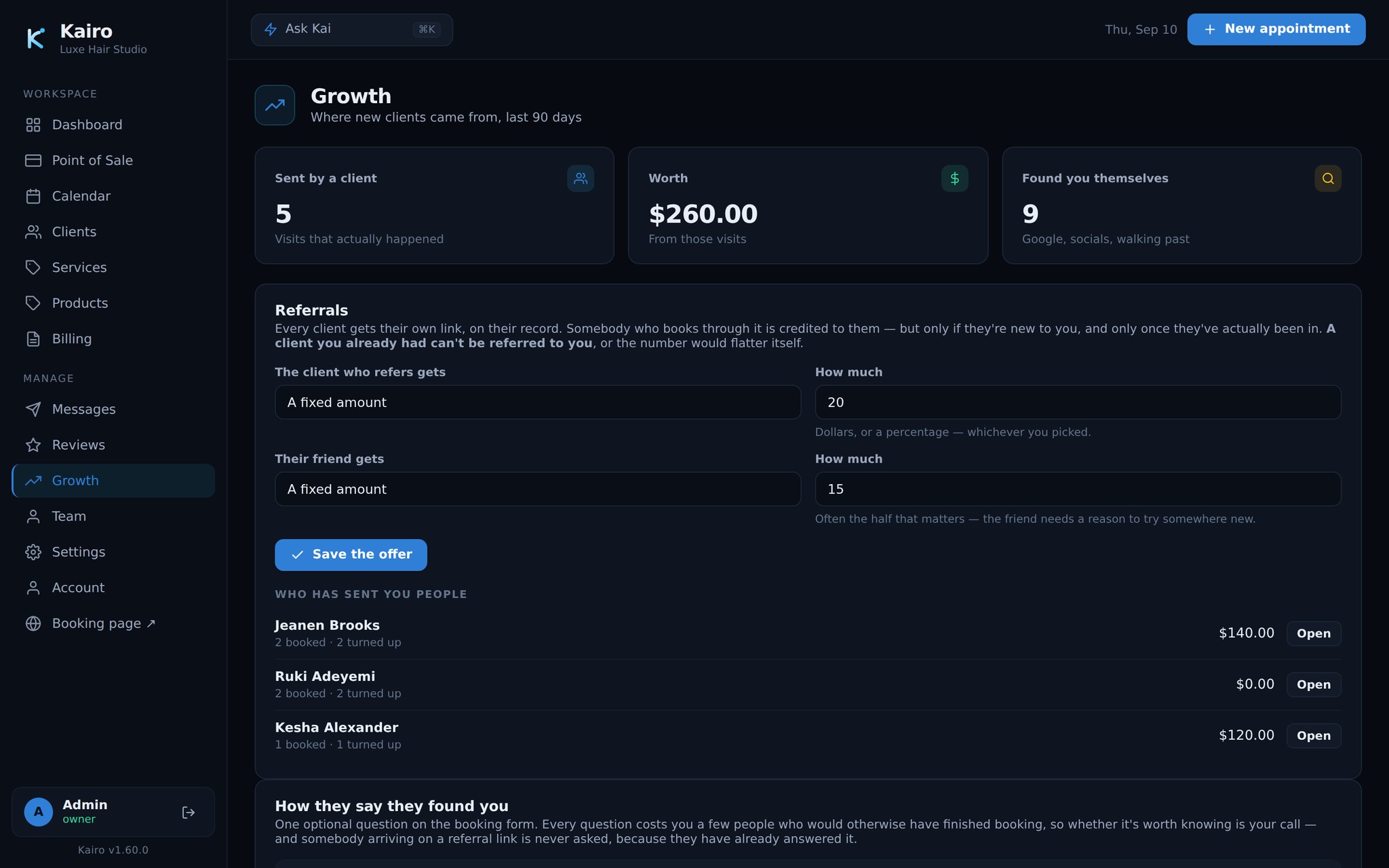
Kairo counts who sent whom and what it was worth — but only once the person has actually turned up, and never for somebody who was already yours. A client you already had cannot be referred to you, or the number would flatter itself.

  • 5

    Sent by a client

    Visits that actually happened

  • $260

    Worth

    From those visits

  • 9

    Found you themselves

    Google, socials, walking past

Kairo's Growth screen: how many visits came from a client's referral link, what they were worth, how many found the salon themselves, the reward set for each side, and which clients have sent people in.

The two halves are reported apart on purpose. Only the people who found you on their own are ones a listing site could claim to have sent — a friend's recommendation was never theirs to take a commission on. That is the number worth holding up against a marketplace, and the one that survives being checked.

No commissionNo monthly fee$410 onceYour own linkNo commissionNo monthly fee$410 onceYour own linkNo commissionNo monthly fee$410 onceYour own link
Your client list stays yoursIts own databaseNo marketplaceYour client list stays yoursIts own databaseNo marketplaceYour client list stays yoursIts own databaseNo marketplace
Reminders that send themselvesPaid in one tapNothing sends silentlyReminders that send themselvesPaid in one tapNothing sends silentlyReminders that send themselvesPaid in one tapNothing sends silently

What it costs

$410 once.Then nothing.

No monthly subscription, no per-booking fee, no commission, and no cut of anything you charge. One payment to set the business up, and then the software is simply yours to run.

Every Kairo includes

  • Your own Kairo, on your own booking link
  • Bookings, calendar, clients, payments and stock
  • Confirmations, reminders and review requests
  • Unlimited team members and services
  • Your data in a file that belongs to you
  • Setup, and your existing client list imported

Your business,running itself.

You did not start a business to chase confirmations. Every hour spent on admin between appointments is an hour nobody paid you for.

Straight answers

Beforeyouask.

01
What is Kairo?
Kairo is booking, payments and client-messaging software for businesses that sell appointments. It runs the diary, the client record, the till, retail stock, the automatic reminders and a public booking page on the business's own link — one system, one login, instead of a diary, a card machine and a separate messaging app. The point of putting them together is time: the admin that normally happens between appointments mostly stops happening.
02
How much does Kairo cost?
Kairo costs a one-off AUD $410 setup fee. There is no monthly subscription, no per-booking fee and no commission on anything the salon charges. The $410 is paid once, before setup, and the software keeps running after that at no further cost.
03
Does Kairo charge a monthly fee or take commission?
No. Kairo has no monthly subscription and takes no commission on bookings, services or retail. The only charges outside the one-off $410 setup fee are a salon's own payment-processing fees, which go to their payment provider, and — if it chooses to text clients — a few cents a text paid directly to its own ClickSend account. None of it goes to Kairo.
04
Who is Kairo for?
Kairo is for any business that runs on booked appointments — hair, barbering, beauty, nails, lashes, clinics, studios and trades that work to a schedule. It was written inside a working business rather than adapted from a general-purpose tool, so it handles the parts that usually cost time: a column per person, service lengths that match how long the job really takes, and prices that can be fixed, "from", or free for a consultation.
05
How is Kairo different from other booking platforms?
The difference is structural rather than a feature list. Kairo gives a business its own branded booking link instead of a listing in a marketplace that also shows competitors, and each business gets its own separate database rather than a row in a shared one. Kairo takes no commission and charges no monthly fee, where booking platforms typically charge a subscription and sometimes a per-booking fee as well. Kairo does not publish other companies' pricing, because it varies by plan and country and changes over time.
06
Who owns the client list and the client data in Kairo?
The business does. Client names, contact details, appointment history and notes belong to the business, and Kairo holds them only as a service provider acting on that business's instructions. Kairo never markets to a customer's clients and never sells client data. A full export is available on request at any time, in a usable format.
07
Does Kairo send appointment reminders and confirmations?
Yes. Kairo sends booking confirmations, appointment reminders, reschedule and cancellation notices and payment receipts automatically. Email works from day one at no cost. Texts go through the business's own ClickSend account, a few cents each, and take about five minutes to switch on with Kairo's step-by-step setup. Every message is logged with its channel and delivery status, so nothing sends silently and nothing fails silently. Marketing messages such as win-backs are kept separate from transactional ones, so a salon can switch marketing off and keep reminders on.
08
Can a salon take payments through Kairo?
Yes. Kairo bills the appointment on the spot or rings up a walk-in in a few taps, handles invoicing and receipts, and tracks retail stock against its margin. Card payments are processed by Stripe; Kairo does not store card numbers.
09
Does Kairo work on a phone?
Yes. Kairo is the same full workspace on a phone as on a desktop, not a cut-down version. On iPhone there is a free Kairo app on the App Store that tells the owner the moment somebody books; on Android it installs to the home screen. It was designed for a thumb first, because most of the working day happens away from a desk with one hand free.
10
Where is Kairo's data stored?
Kairo stores customer data on servers in Singapore, the closest region to Australia that our host offers, and handles it under the Australian Privacy Principles. Each business has its own database rather than sharing a table with other businesses, so no query can return another business's records by mistake. Card payments are handled by Stripe and messages are sent through named email and SMS providers, all listed publicly on Kairo's sub-processors page.
11
How long does it take to get set up on Kairo?
About ten minutes. Signing up and paying online takes around four, and Kairo's guided setup then walks through the service menu, team, hours and booking page in about five more. Importing an existing client list, and any part of the setup a business would rather hand over, is done with them as part of the one-off $410 fee. A business that decides within 14 days of paying that Kairo is not right for them gets the full $410 back, without having to justify it.
12
How do I get started with Kairo?
Press Sign up at kairobookings.com. It asks for the business name, an email and a mobile, checks both with a code, takes the one-off $410 by card, and the business's own Kairo is ready within a minute. Anyone who would rather see it running first can use the contact form on the same site, and a walkthrough is arranged from there.